 En
 English
 Français
 русский
 中文简体
 عربى
 Español


A bucket elevator belt tension calculation is finished when you have four numbers: the peripheral force Fu at the head pulley, the slack-side tension T2, the tight-side tension T1 = T2 + Fu, and the belt's rated tension per millimetre of width.
Fu is the total force the drive has to overcome to lift material and drag the belt, buckets and shafts around. T2 is the tension the take-up puts into the belt at the boot; without it, the belt simply slides over the head pulley. The two are tied together by pulley friction, because the ratio T1 ÷ T2 can never exceed e(μθ), where μ is the friction coefficient between belt and pulley and θ is the wrap angle in radians.
The worked example used throughout this article is a 60 t/h fertilizer elevator lifting 30 m at 1.4 m/s, a size that appears on most compound fertilizer lines.
Inputs to collect before touching a formula
Missing one of these nine values is usually what turns a tidy calculation into a 20-30% error.
| Symbol | Meaning | Example value |
|---|---|---|
| Q | Rated capacity, t/h | 60 |
| H | Lift height, centre to centre, m | 30 |
| v | Belt speed, m/s | 1.4 |
| qm | Material mass per metre of belt, kg/m | 11.9 |
| qB | Belt mass per metre, kg/m | 9.0 |
| qG | Bucket mass per metre, kg/m | 14.0 |
| μ | Belt-to-pulley friction coefficient | 0.35, lagged |
| θ | Wrap angle, radians | 3.14, i.e. 180° |
| η | Drive efficiency, gearbox and coupling | 0.92 |
Use the rated duty, not the maximum the buckets could physically hold. Belt elevators are normally sized 10-20% above their duty point so buckets discharge cleanly instead of carrying material back down the return strand.
Step 1: convert capacity into mass per metre of belt
Lifting load depends on kilogrammes per metre, not tonnes per hour, so convert first: qm = Q ÷ (3.6 × v). For 60 t/h at 1.4 m/s that is 60 ÷ (3.6 × 1.4) = 11.9 kg/m.
Pure lifting force is then 9.81 × 11.9 × 30 = 3 500 N, or 3.5 kN. That is the useful part of the load, and on its own it is never enough to size a drive.
Material behaviour decides how much margin you carry on top of it. Dry compound fertilizer discharges almost completely, while sticky, high-moisture feed clings to buckets and rides back down the return strand as dead weight. Organic fertilizer production lines handle this with wider bucket clearances and lower speeds, and both factors change the loss coefficient you should apply.
Step 2: build the peripheral force
Answer first: for most belt elevators, Fu = 9.81 × qm × H × k, with k between 1.15 and 1.35.
The factor k absorbs everything that does not scale neatly with height: scooping resistance as buckets dig into the boot, belt and bucket flexing around pulleys, bearing friction at the head and boot shafts, and residue carried on the return strand.
With k = 1.25, the example gives Fu = 9.81 × 11.9 × 30 × 1.25 = 4 380 N, or 4.4 kN.
A useful short cut when checking quotations: Fu ≈ 3.4 × Q × H ÷ v, which returns 4 371 N here.
| Component | Share of Fu |
|---|---|
| Lifting the material | 75-85% |
| Scooping at the boot | 5-12% |
| Bearings, belt flexing, residual material | 8-15% |
Step 3: pulley friction sets the slack-side tension
Answer first: T2 must be at least Fu ÷ (e(μθ) - 1), and T1 is then T2 + Fu.
A clean lagged pulley at 180° wrap gives μθ ≈ 1.10 and e1.10 ≈ 3.0, so T2 ≥ 4.4 ÷ 2.0 = 2.2 kN and T1 = 6.6 kN.
Treat that Euler value as a floor rather than a target. A dust film, oil mist or glazed lagging drops μ to 0.20-0.25 and lifts the required T2 by half again. Adding 20-30% of margin gives a design T2 of roughly 2.8 kN and a design T1 of roughly 7.2 kN.
| Belt-to-pulley friction μ | Wrap angle θ | e(μθ) | Minimum T2 ÷ Fu |
|---|---|---|---|
| 0.25, dry steel pulley | 180° | 2.19 | 0.84 |
| 0.30, dusted lagging | 180° | 2.57 | 0.64 |
| 0.35, clean lagged pulley | 180° | 3.00 | 0.50 |
| 0.35, lagged with snub pulley | 210° | 3.60 | 0.38 |
| 0.40, rubber lagging | 200° | 4.04 | 0.33 |
Step 4: the four checks that catch a bad answer
Run these before the calculation leaves the office, because each one has cancelled a project at some point.
- Belt strength. Divide T1 by belt width in millimetres and compare with the belt's rated tension. Keep a safety factor of at least 10 for a fabric belt with mechanical splices, and 8 for a vulcanised joint. On fertilizer elevators the belt is usually selected by bucket width, so this check confirms margin rather than sizes the belt.
- Drive power. Shaft power is Fu × v ÷ 1000 = 4.4 × 1.4 = 6.1 kW. Divide by drive efficiency (6.1 ÷ 0.92 = 6.7 kW) and apply a service factor of 1.15-1.25. If the elevator restarts fully loaded, take the next standard motor size up.
- Starting torque and shaft load. Head shaft torque is Fu × pulley diameter ÷ 2. With a 630 mm pulley that is 1.4 kN·m, and this figure, not the belt rating, often decides the gearbox.
- Take-up travel. Allow at least 1% of the lift plus 150 mm. A new belt takes up 0.5-1.5% of centres in its first month, and a screw take-up that bottoms out ends the discussion.
Belt or chain: where the calculation changes
Chain elevators have no Euler limit. A chain only needs enough tension to stay seated on the sprocket, so T2 can be a small fraction of Fu, and the chain's own weight becomes the largest single load and the main reason chains and sprockets wear.
Belt machines run faster, typically 1.0-1.6 m/s against 0.4-0.8 m/s for chain, and handle fragile fertilizer granules with less breakage. Chain units tolerate higher temperatures and stickier material, but ask more of maintenance. For belt duty on fertilizer, the TH series is the usual centrifugal-discharge choice.
 TH Series Chain Bucket Elevator for Bulk Material LiftingChain-type vertical elevator with four models, deep or shallow buckets, 0.65–47.2 m³/h capacity, and 4.52–30.32 m lift; chain traction suits hot or sticky bulk duties.View Product →
Field verification and tolerances worth writing into the specification
The cleanest way to check your arithmetic is to measure T2 directly: on a gravity take-up, T2 equals the take-up mass × 9.81, ignoring friction in the guides.
| Check | Typical value |
|---|---|
| Belt speed against design | Within ±5% |
| Motor current at rated duty against calculated | Within ±10% |
| Take-up travel remaining after one month | At least 1% of lift plus 150 mm |
| New belt elongation in the first four weeks | 0.5-1.5% of centres |
| Bucket clearance to casing | 20-40 mm |
| Head pulley temperature rise after a full shift | Above 15 °C is a slip warning |
If the belt slips while the take-up looks correct, inspect the lagging before adding tension. Worn or glazed rubber can halve μ, and no reasonable increase in take-up force will restore grip that the pulley surface no longer provides.
Mistakes that quietly add 20-30% to the real tension
- Using maximum bucket capacity instead of the rated duty, which oversizes every downstream component.
- Assuming μ = 0.35 on a pulley that has never been cleaned and sits under a dust hood.
- Ignoring cold starts, where thick gear oil plus a boot full of material push breakaway torque to 1.3-1.5 times the running value.
- Sizing take-up travel for a belt that has already been run in and stretched.
- Treating the return strand as empty when material fails to discharge and rides back down as dead weight.
Frequently asked questions
Can I estimate belt tension from capacity and height alone?
Yes, to within roughly 20%. Use Fu ≈ 3.4 × Q × H ÷ v, then T2 ≈ Fu ÷ 2 for a clean lagged pulley at 180° wrap, and T1 = T2 + Fu. That is good enough to challenge a quotation, not to buy a belt.
Why does the belt slip when the tension is correct?
Because μ has changed rather than the tension. Grease, dust, a glazed or worn lagging, or a pulley crown that no longer matches the belt profile all reduce the friction coefficient, so the required T2 climbs by 50% or more. Inspect the pulley surface first.
Gravity or screw take-up?
Gravity take-up holds T2 constant as the belt stretches, which matters on towers above 20 m. Screw take-up is cheaper and perfectly adequate on short elevators, provided somebody is scheduled to re-tension it after the first month and periodically afterwards.
Do I need a snub pulley?
Only when a plain 180° wrap cannot deliver the required T2 without over-tensioning the belt. A snub pulley at 210° cuts the required T2 by roughly a quarter, at the cost of an extra bend and one more wear point to inspect.
A tension calculation is a twenty-minute exercise once the inputs are on the table, and the value is in the checks rather than the arithmetic. Verify T1 against belt width, verify motor and gearbox against start-up torque, and verify T2 against a take-up you can actually measure.
In a complete fertilizer line the elevator sits between the cooler and the screen, so its duty point is fixed by everything around it, which is why the number is worth getting right instead of adding another 20% to every component. To compare your result against machines that are already running, the Alisen equipment catalogue lists capacities, lift heights and drive ratings for belt and chain elevators.
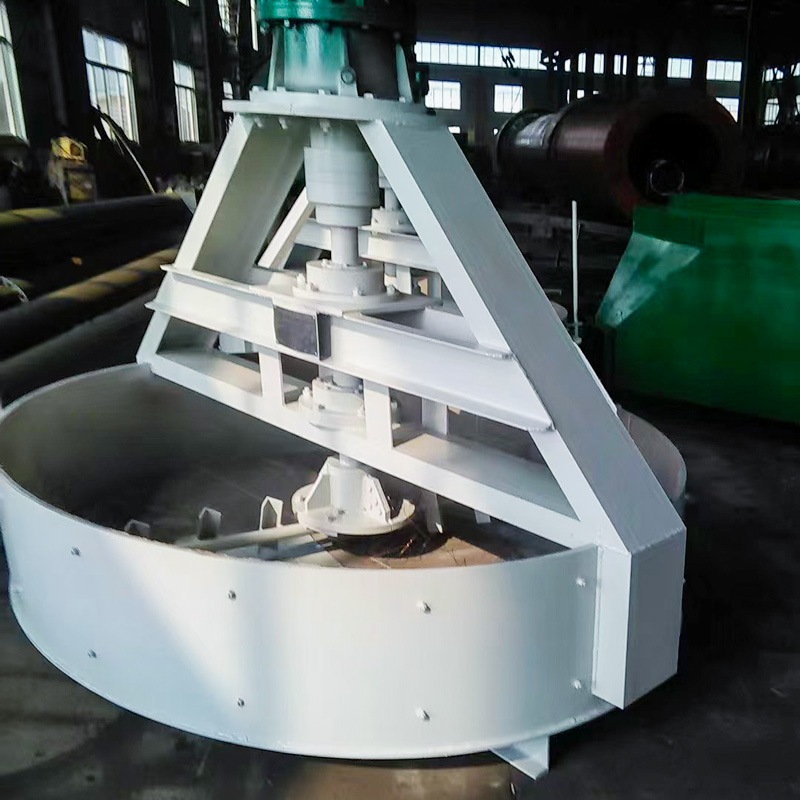 Compound Fertilizer Production Line for NPK Granulation and ProcessingComplete NPK compound fertilizer system covering raw material handling, mixing, granulation, drying, cooling, screening, coating, and packaging, with rotary drum, disc, or extrusion granulation options.View Product →