
 En
En
 English
  Français
  русский
  中文简体
中文简体  عربى
عربى  Español
alisen
alisen
alisen
alisen
alisen
alisen
alisen
alisen
alisen
alisen
alisen
alisen
Industry News
Why Is the Vertical Roller Mill Becoming the Global Standard for Industrial Grinding?

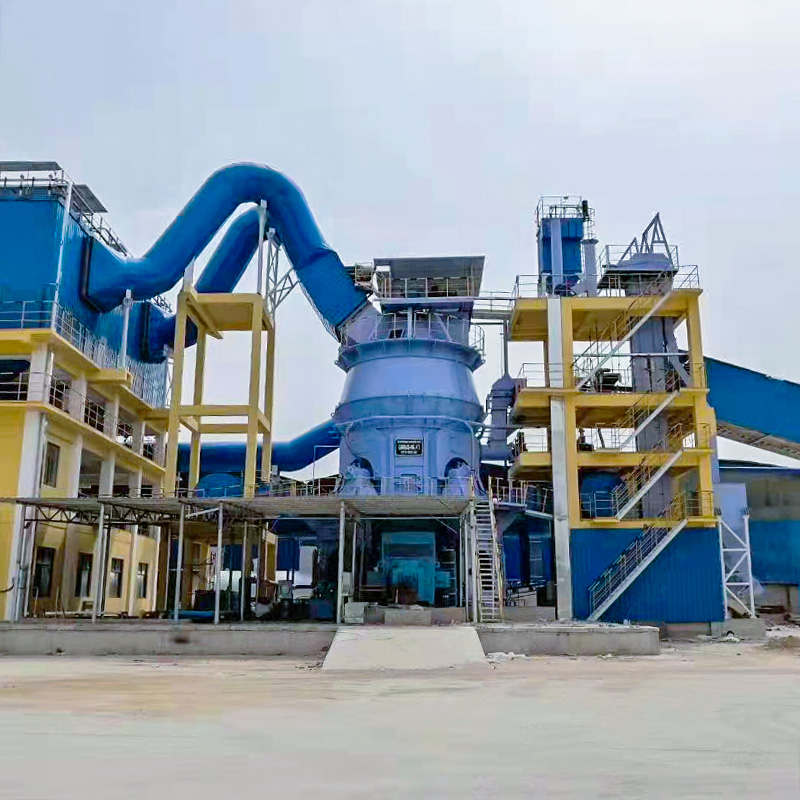
Vertical Roller Mill (VRM) technology is the most efficient solution for grinding raw materials, cement clinker, and coal because it integrates crushing, drying, grinding, and classifying into a single, compact system. Compared to traditional ball mills, a Vertical Roller Mill can reduce energy consumption by up to 30-50% while offering superior flexibility in handling moisture-heavy materials.
How Does a Vertical Roller Mill Outperform Traditional Grinding Systems?
The Vertical Roller Mill outperforms traditional systems by utilizing a "material bed grinding" principle, which is significantly more energy-efficient than the impact-based grinding used in ball mills. This mechanism ensures that the pressure is applied directly to the material layer, minimizing metal-to-metal contact and reducing wear rates.
In heavy industries such as cement production and power generation, the demand for high-throughput and low-energy machinery has never been higher. The Vertical Roller Mill addresses these needs by combining four distinct processes into one unit. Below is a detailed breakdown of its operational advantages:
- Energy Efficiency: It consumes roughly 20-25 kWh/t for cement raw material grinding, whereas ball mills often exceed 35-40 kWh/t.
- Drying Capacity: The mill uses hot exhaust gases to dry materials with up to 15-20% moisture content during the grinding process.
- Space Requirement: A Vertical Roller Mill setup requires 50% less space than a traditional multi-stage grinding circuit.
What Are the Core Technical Components of a Vertical Roller Mill?
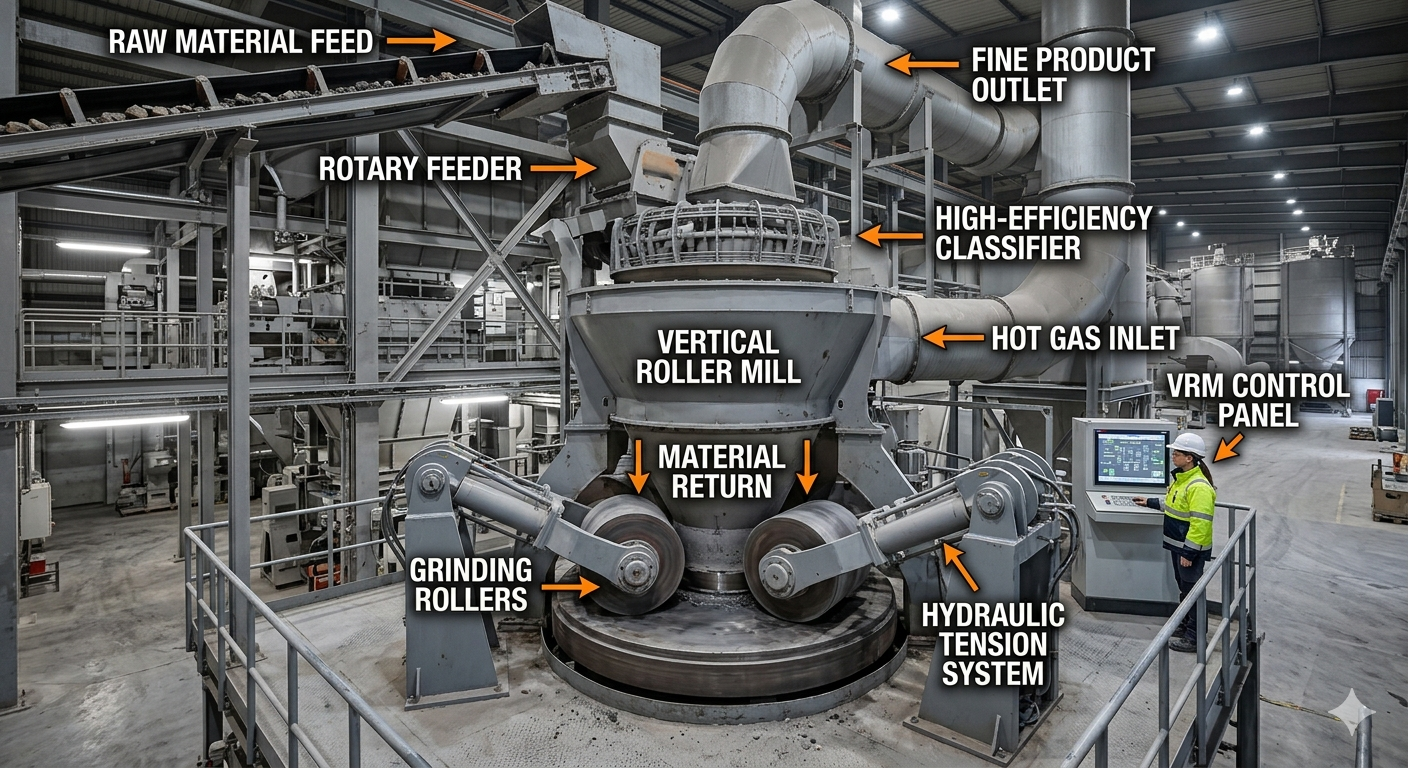
The core components of a Vertical Roller Mill include the grinding table, the rollers, the hydraulic system, and the high-efficiency classifier, all working in synergy to produce precise particle sizes. The interaction between the rotating table and the stationary rollers creates the shear and compressive forces necessary for fine grinding.
The Grinding Table and Rollers
The grinding table is the primary rotating component, driven by a high-torque gearbox, while the rollers are pressurized against it to crush the material. The shape of the rollers (tapered or cylindrical) is optimized to ensure uniform wear and consistent product fineness over thousands of operational hours.
The Hydraulic Tensioning System
The hydraulic system provides the necessary grinding force and acts as a buffer to prevent damage from ungrindable items like tramp metal. Modern Vertical Roller Mill units feature automated hydraulic controls that adjust pressure in real-time based on the material hardness and feed rate.
How Do Vertical Roller Mills Compare to Ball Mills?
The primary difference lies in the grinding efficiency and the process footprint, where the Vertical Roller Mill offers a more integrated and cost-effective solution for large-scale operations. While ball mills are simpler to maintain, their high noise levels and massive energy waste make them less sustainable for modern environmental standards.
| Feature | Vertical Roller Mill | Traditional Ball Mill |
|---|---|---|
| Grinding Principle | Compression & Shear | Impact & Attrition |
| Power Consumption | Low (70-80% of Ball Mill) | High (100%) |
| Process Stages | Single (Grind/Dry/Classify) | Multiple (Separate units) |
| Noise Level | 80-85 dB | Over 100 dB |
| Feed Moisture | Up to 20% | Less than 3% |
Table 1: Comparative analysis between Vertical Roller Mill and Ball Mill technology.
Why is Moisture Handling a Game Changer for the Vertical Roller Mill?
The Vertical Roller Mill uses high-velocity hot air to lift and dry particles simultaneously, allowing it to handle feed materials with significantly higher moisture levels than any other mill type. This eliminates the need for expensive external rotary dryers, saving both capital expenditure (CAPEX) and operational expenditure (OPEX).
For example, in a slag grinding application, the raw slag often contains 10-15% water. A ball mill would require a separate drying furnace, consuming massive amounts of fuel. In contrast, a Vertical Roller Mill utilizes waste heat from the kiln system to dry the slag within the mill housing, achieving a final product moisture of less than 1%.
What Are the Economic Benefits of Implementing a Vertical Roller Mill?
The economic benefits of a Vertical Roller Mill include a faster Return on Investment (ROI) due to lower electricity bills, reduced foundation costs, and simplified maintenance routines. By consolidating equipment, plants can reduce their spare parts inventory and lower the man-hours required for system oversight.
Reduction in Specific Power Consumption
Electricity represents roughly 60-70% of the total operating cost of a cement plant. A Vertical Roller Mill reduces the specific power consumption for grinding raw meal from 32 kWh/t to approximately 24 kWh/t. For a plant producing 5,000 tons per day, this equates to thousands of dollars in daily savings.
Lower Maintenance and Wear Costs
While the initial cost of Vertical Roller Mill rollers can be high, they are designed for longevity. Modern "hard-facing" techniques allow rollers to be welded and refurbished in-situ, extending their life cycle to over 20,000 hours of operation depending on the abrasiveness of the material.
FAQs: Understanding the Vertical Roller Mill
Q: Can a Vertical Roller Mill grind extremely abrasive materials?
A: Yes, with specialized wear-resistant alloys and proper ceramic inserts, modern mills can handle abrasive materials like quartz or iron ore, though wear part replacement cycles will be shorter.
Q: What is the typical fineness achieved by a Vertical Roller Mill?
A: It can easily achieve a fineness of 3,000 to 5,000 cm²/g (Blaine value) for cement or 90% passing 80 microns for coal, thanks to the integrated high-efficiency cage classifier.
Q: How does the mill handle "vibration" issues?
A: Vibrations are usually caused by an unstable material bed. This is managed by water spraying systems to increase material cohesion and advanced hydraulic damping systems.
Q: Is a Vertical Roller Mill suitable for small-scale operations?
A: While highly efficient for large capacities (up to 600 tph), the complexity and initial cost might be high for very small workshops; however, modular designs are making it more accessible.
Conclusion: Is the Vertical Roller Mill the Right Choice?
The Vertical Roller Mill is undeniably the right choice for any industrial facility looking to modernize, reduce carbon footprints, and maximize operational profitability. Its ability to combine multiple industrial processes into a single, automated, and energy-efficient machine makes it the cornerstone of the 21st-century mining and cement industries.
By investing in Vertical Roller Mill technology, companies are not just buying a grinder; they are adopting a sustainable process that ensures long-term competitiveness in an increasingly energy-conscious global market.

GET IN
TOUCH WITH US
TOUCH WITH US
-
 No.68, Shuanglou Road, Qutang Town, Haian City, Nantong, Jiangsu
 -
Tel:
 +86-13914355558/18994158908
 -
E-mail:
 sales@tp-machinery.com
COPYRIGHT © 2025 Nantong Alisen Environmental Protection Technology Co., Ltd.
ALL RIGHTS RESERVED.
China fertilizer machinery manufacturer wholesale fertilizer machinery factory
