
 En
 English
 Français
 русский
 中文简体
 عربى
 Español

alisen
alisen
alisen
alisen
alisen
alisen
alisen
alisen
alisen
alisen
alisen
alisen
Industry News
Vertical Mixer Guide: Working Principle, Sizing and Buying Advice for Plants

A vertical mixer is a batch blender built around a vertical screw inside a conical or cylindrical hopper: the screw lifts material from the bottom, the material cascades back down the walls, and the whole batch circulates and recombines within a few minutes. The practical answer to "do I need one" is short. If you blend dry, free-flowing granules or powders in batches of roughly 0.5 to 10 m³, want a fast cycle and a small footprint, a vertical mixer is usually the least expensive route to a uniform blend. If your material is sticky, high-moisture, or needs liquid added at more than a few percent, a horizontal machine will serve you better.
That single trade-off, free-flowing versus cohesive, drives most of the specification decisions below, from the fill level you can run to the discharge gate you should order. It is also why two mixers with identical nameplate volume can behave very differently on the same plant floor.
What actually happens inside the hopper
Nothing stirs the batch the way a paddle does; the material mixes itself, and that is the key to both the efficiency and the limits of this design. A vertical screw, either mounted centrally or carried around the vessel on an orbiting arm, drags material up from the bottom of the cone. Gravity returns it down the outside, so the batch travels in a closed loop and layers are continuously folded into one another. With a typical free-flowing fertilizer or feed blend, three to eight minutes of circulation is enough to reach a coefficient of variation around 5% on the key nutrient or additive.
Three consequences follow from that mechanism, and they matter more than catalogue wording:
- Low shear, low breakage. Granules are lifted and dropped rather than sheared against a trough wall, so fines generation stays low, which is valuable when your product is sold on granule appearance.
- Low specific power. A vertical mixer moves a large batch with a comparatively small motor because it lifts only the central column, not the entire bed.
- Sensitivity to over-mixing. Past the point of uniformity, continued circulation can cause segregation of particles that differ in size or density, so a timer set "just to be safe" often makes the blend worse, not better.
The discharge arrangement deserves equal attention. A full-bottom or large slide gate empties the cone quickly with little residual heel; a small side outlet leaves material sitting in the cone, and that carry-over becomes cross-contamination between recipes.
Vertical or horizontal: choose by material, not by price
Start from the material and the batch size, then look at price; reversed, that order produces most of the mixers that end up idle in a corner of the plant.
| Criterion | Vertical mixer | Horizontal mixer |
|---|---|---|
| Floor space and height | Small footprint, tall vessel, often needs headroom or a raised platform | Larger footprint, lower profile, easier to fit under an existing structure |
| Practical batch volume | Commonly 0.5 to 10 m³, scaled up with cone diameter | Typically 0.25 to 6 m³ per batch at similar power |
| Mixing cycle | 3 to 8 minutes for free-flowing granules | 2 to 6 minutes, with more aggressive shear |
| Residual material and cleanout | Good with a full-bottom gate, poor with a small side outlet | Generally easier to clean between recipes |
| Granule integrity | High, low fines generation | Moderate, paddles and ploughs break fragile granules |
| Sticky or high-moisture material | Poor, material bridges and smears on the cone wall | Good, especially with choppers or liquid injection |
| Best fit | Dry blending, BB fertilizer, feed, premix, mineral powders | Wet granulation feed, pastes, high liquid addition, short cycles with tight uniformity targets |
For a blending plant that shifts between recipes several times a day, the vertical design usually wins on cost per tonne and on granule survival. For a line that adds molasses, urea solution or water at 5% or more, the horizontal design is not a luxury; a vertical mixer will simply coat its own cone and stop circulating.
Specifications that decide whether it works on your line
The number printed largest in the brochure, total volume, is the least useful figure for comparison; working volume at a realistic fill level tells you what the machine will actually do.
- Fill level. Most vertical mixers run best between 60% and 70% of total volume. Buy on working volume, and confirm that the figure quoted is working, not gross.
- Bulk density. A 3 m³ cone handles about 2 tonnes of material at 0.7 t/m³ but under 1.2 tonnes of light urea-based blend. Light products need more volume or more screw torque than the volume alone suggests.
- Screw diameter and speed. Larger screws at lower speed move more material per revolution and are gentler on granules; high-speed small screws are cheaper but generate fines.
- Drive and power. Check the installed motor against your heaviest recipe, not the average one. Starting torques on a full cone are higher than running torques.
- Discharge design. Pneumatic full-bottom gates empty in under a minute; manual slide gates slow the cycle and leave a heel.
- Construction and wear. Carbon steel with a painted exterior is normal for dry fertilizer; stainless contact parts or an abrasion-resistant liner suit abrasive mineral powders and salty blends.
- Dust control and access. The mixer needs an aspiration point and a sealed charging port, plus a hinged inspection cover large enough for a person to inspect the screw flighting without dismantling the machine.
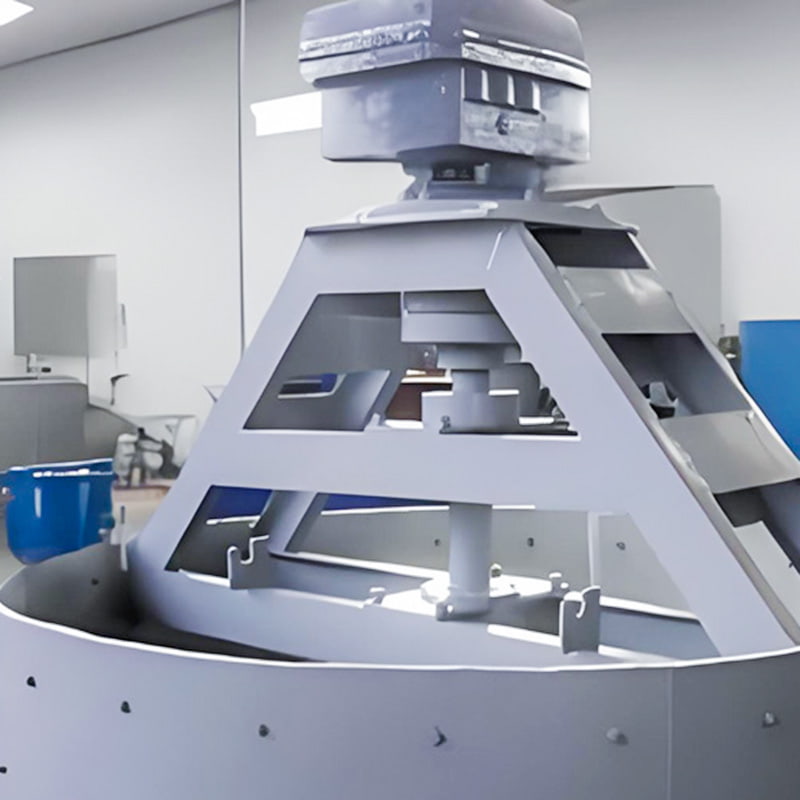 Vertical Mixer for Compound Fertilizer ProductionCheck working volume at realistic fill levels; this vertical mixer homogenises pre-crushed fertilizer materials between batching and granulation.View Product →
Where a vertical mixer sits in a fertilizer line
In a compound fertilizer line the mixer normally sits between batching and granulation, or, in a blending plant, between screening and bagging; its job is to make the batch homogeneous before the next step changes it irreversibly.
Typical duties include pre-blending micronutrients and fillers into a carrier, distributing recycle fines back into fresh material, and homogenising a BB blend before bagging. Where the mixed material feeds a pan or drum granulator, the mixer is often specified together with a pan-type unit that combines blending and pelletising in one vessel, which shortens the flowsheet and reduces conveying between stages. You can see how these units sit beside batching, crushing, conveying and dust collection in the wider industrial mixing and agitation equipment range, and it is worth checking that the mixer you pick can be integrated with the aspiration and discharge heights of the rest of the line.
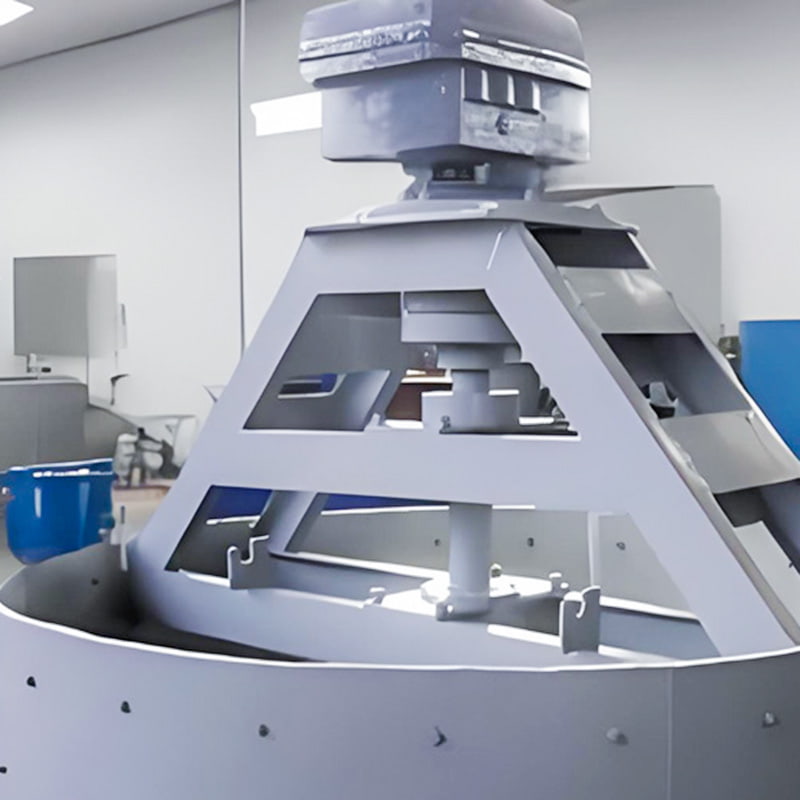 Pan Mixer for Compound Fertilizer BlendingUseful for pre-blending micronutrients or homogenising BB blends before bagging, with a lined pan that reduces sticking and supports continuous operation.View Product →
Batching accuracy matters more than mixing hardware
A vertical mixer cannot repair a batch that was weighed wrong; a 1% weighing error on a nutrient stays a 1% error in every tonne that leaves the plant, no matter how uniform the blend appears.
Before comparing mixer prices, check the accuracy of the batching scale upstream, the repeatability of the belt or screw feeders, and whether the control system compensates for the material already in flight when the feeder stops. In practice, plants that upgrade weighing and feeder control see a larger improvement in product consistency than plants that buy a bigger mixer. The mixer's contribution is to distribute what the scale delivered, evenly and quickly, without breaking it down.
 Belt-Type Fertilizer Batching Scale for Accurate FeedingCheck upstream weighing first: this belt scale measures weight and speed to control feed rate with ≤1% metering error.View Product →
Six buying risks worth checking before you sign
Most disappointments with vertical mixers trace back to specification shortcuts rather than manufacturing defects, and each of them is visible on a quotation if you know where to look.
- Sizing on total volume. A 5 m³ cone filled to 65% mixes 3.25 m³ per batch, not 5. Confirm the working figure in writing.
- Ignoring bulk density. Light blends need more volume; dense mineral powders need more torque. Both are quoted as "5 m³".
- Undersized discharge. A slow gate extends the cycle and leaves a heel that contaminates the next recipe.
- No cleanout access. Recipe changes in a blending plant demand an inspection cover and a smooth interior with no ledges.
- Dust left unaddressed. An unaspirated charging port turns every batch into a housekeeping problem and a compliance risk.
- Treating vertical as universal. It is an excellent dry blender and a poor wet one; match the machine to the material rather than to the budget line.
Frequently asked questions
How full should a vertical mixer be loaded?
Usually 60% to 70% of total volume. Below about half, the screw lifts material into empty space and the circulation loop weakens; above roughly 75%, the drive labours and the top layer barely moves.
Can a vertical mixer handle damp or sticky material?
Only mildly damp, free-flowing material. Once moisture makes the blend cohesive, it bridges above the screw and coats the cone wall, and mixing efficiency drops sharply. For pastes or high liquid addition, specify a horizontal design.
What mixing time and uniformity can I expect?
For a typical dry granule or powder blend, three to eight minutes of circulation usually reaches a coefficient of variation near 5%. Longer is not better; over-mixing can separate particles that differ in size or density.
Is a vertical mixer suitable for BB fertilizer blending?
Yes, it is one of the most common choices, because the gentle lifting action keeps prilled and granular particles intact and limits the fines that cause caking in storage.
Which parts wear out first?
The screw flighting, the bottom bearing or gearbox seal, and the discharge gate. Specify replaceable flighting sections and a bearing arrangement that can be serviced through the inspection cover rather than from underneath the cone.
A vertical mixer is a simple machine that rewards careful specification: working volume at your real fill level, torque matched to your densest recipe, a discharge that empties completely, and an aspiration point that keeps the charging area clean. Get those four right and the mixer becomes the quietest, cheapest stage in the whole line. If you are still comparing configurations, the product centre sets out the mixing, batching, conveying and dust-control equipment that normally surrounds a mixer, so you can plan the complete flow rather than a single machine.


GET IN
TOUCH WITH US
-
 No.68, Shuanglou Road, Qutang Town, Haian City, Nantong, Jiangsu
-
Tel:
 +86-13914355558/18994158908
-
E-mail:
 sales@tp-machinery.com
COPYRIGHT © 2025 Nantong Alisen Environmental Protection Technology Co., Ltd.
ALL RIGHTS RESERVED.
China fertilizer machinery manufacturer wholesale fertilizer machinery factory
